
Humane Fox Deterrence
Long-term solutions that help resolve fox-related issues without harming wildlife.
Get AdviceUnderstanding fox behaviour
Living alongside urban foxes can occasionally bring challenges, but in most cases there is no need to harm or remove these intelligent wild animals.
Humane fox deterrence focuses on understanding fox behaviour and using that knowledge to encourage foxes to avoid certain areas, creating a long-term solution that benefits both people and wildlife.

Why are foxes visiting my garden?

Digging
Foxes may dig while searching for insects and worms, creating temporary resting places, establishing dens or making routes through their territory.

Fouling
Fox droppings are a natural form of communication. Foxes use droppings and scent marking to advertise their presence to other foxes.

Noise
Foxes can be surprisingly vocal, especially during breeding season and when cubs are being raised. Their calls are part of normal communication.
Deterrence works because foxes learn
Unlike trapping or killing, deterrence works by changing how foxes interact with your property. The fox remains within its own territory but learns that certain areas are unpleasant, inaccessible or not worth visiting.
This matters because if one fox is removed, another will usually move into the vacant territory and may quickly repeat the same behaviours.

Using repellents effectively
Because foxes rely heavily on scent and territory, deterrents can be effective when used correctly.
Commercial wildlife repellents can help discourage foxes from using particular areas of your garden by creating unfamiliar scents that foxes may choose to avoid.
These products are widely available from garden centres and hardware stores and should always be used according to the manufacturer’s instructions.
Humane deterrence methods
Repellents
Apply to affected areas and reapply regularly, especially after rainfall.
Motion Sprinklers
A short burst of water safely teaches foxes to avoid specific locations.
Secure Food Sources
Secure compost bins and remove accessible food that may attract foxes.
Protect Beds
Use mesh, fencing or covers to protect flowerbeds and newly laid turf.

Motion-activated sprinklers can be extremely effective without causing harm.
Simple changes can make a big difference
Not all deterrents involve scent-based products. You can also reduce fox activity by removing attractions and making vulnerable areas harder to access.
Useful measures include securing compost bins, removing accessible food sources, protecting flowerbeds and blocking access beneath sheds or decking once you are certain no foxes are using them.
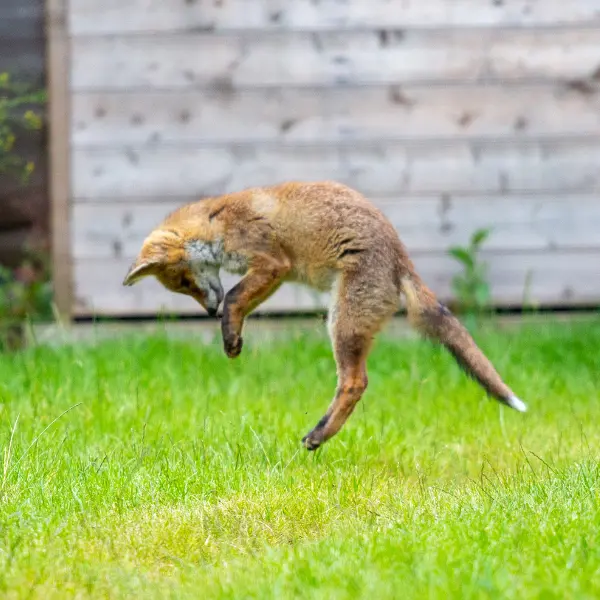
Always check before blocking access
Before blocking access beneath sheds, decking or outbuildings, you must be absolutely certain that no foxes or cubs are inside. Blocking an active den can trap animals and cause serious suffering.
Removing foxes does not solve the problem
Many people assume that relocating or removing foxes will fix the issue. In reality, fox territories do not remain empty for long.
If one fox is removed, another fox will usually move into the area and establish the territory as its own. Long-term solutions focus on managing behaviour rather than removing animals.

Sharing space with wildlife
Foxes are a natural part of Britain’s urban and rural landscapes. With the right approach, most conflicts can be resolved through simple, humane deterrence methods.
By understanding why foxes behave in a certain way and making small changes to your garden or property, it is usually possible to discourage unwanted behaviour while allowing foxes to remain safely in their territory.
Need help with a fox problem?
In most cases, fox-related issues can be resolved without trapping, relocating or harming the fox. Fox-A-Gon provides expert humane deterrence advice designed to create lasting solutions for both people and wildlife.
Learn More About Fox-A-Gon